Monday, October 3, 2011

THE PERFECT STRINGOUT by Steven Friedland


“The Perfect Stringout”
A blog by Steven Friedland

So, what is a stringout?  Simply put, a stringout is a sequence of shots that a Story Producer assembles and gives to an Editor to serve two purposes; 1) to give the Editor a “head start” on getting through the raw material that has been shot, and, 2) to give the Editor a “road map” on what the story of a specific scene should be.  Very often, the raw material of a reality show is random and unfocused, and decisions need to be made early on as to what the focus of scene should be.  The Story Producer will look at all the material for an episode and, together with the Supervising Story Producer/Co-Executive Producer, create a story arc of the episode.  The Story Producer will then sort through the raw footage and start creating sequences from the raw material that reinforce the central story arc to the episode.

Just so you know, I am writing this blog from the point of view of an Editor talking to a Story Producer.  Every production company handles story and stringouts in different fashions.  Often, a Story Producer will have to submit their stringouts to a Supervising Story Producer and get notes on them before an Editor ever sees them.  Other production companies prefer the Editor to watch ALL the raw and it is the job of the Story Producer to only pull interview bites for the Editor.  There are no “hard and fast rules” to the stringout, so if you are called upon to create one, use your best judgement.  And know, a stringout should be treated as an expression of your creativity.

So, what goes into “the perfect stringout”?  Well, that can be a bit tricky.  As an Editor, I prefer my stringouts to include any, and all, footage that could possibly be included in the final sequence, but at the same time, I prefer only “the best of the best”.  That would include all the best moments of reality, the best b-roll, interview bites and insert shots.  But only “the best of the best” – meaning, use your taste and select the best takes of interview bites (especially if there are multiple takes), and the moments that best express the story in the MOST CONCISE WAY.  Be selective.  Analyze performance and nuance.  Look for reaction shots that are provocative and telling.  This is YOUR opportunity to express your storytelling skills, so be brave and assert yourself.  But also, you don’t want to overwhelm the editor with options, otherwise the editor could just look at the raw material on their own.  Your stringout DOES NOT need to be an edit.  It is simply a series of shots in a timeline.  Don’t feel you need to make it look like an edited sequence ready for television. And DON’T ADD MUSIC TO YOUR STRINGOUT - !!  it is a waste of your time.

On average, a “scene” in a typical show runs between 2-3 minutes in length.  The raw material for a scene could be 1-2 hours in length, possibly even longer.  So, I don’t think a stringout in the 15-25 minute range is outrageous.  Of course, it needs to be the right 15-25 minutes of material.    If a conversation goes off on multiple threads/tangents, select the most pertainent conversation/s to the story.  Include any conversation that you feel is pertinent to the story/theme of the episode, but  DO NOT INCLUDE every conversation.  Make choices.  Also, make sure you include ALL entrances and exits of major characters, and any greetings and goodbyes of major characters.  Though, it will ultimately be up to the editor on whether these will be included, it can be a chore to have to scour through the footage to find these moments.

But most importantly, a stringout is the foundation for a scene; the basis for what the story of the scene will ultimately be.  It will go through multiple renditions before it makes it way to the television screen or the cutting room floor.  It can be and should be used as a tool to start conversations on what is the story of a scene.  Above all, any stringout that is prepared with insight and consideration, I consider to be a perfect stringout.


 --Steven Friedland is an Avid/Final Cut Pro editor for television and feature films.  Some of his current credits include "Real Housewives of the OC," "Modern Marvels," "Life on a Wire," and the upcoming feature film "Donner Pass."

Thursday, September 29, 2011

This means WAR!

Above is an example of what's known as a Wide Area Release.  When shooting in a public place, theater, or anywhere there will be a large group of people, you will need to use a wide area release.  These should be made into posters that are about three feet tall, posted at every entrance to the location, and you'll need to have the camera crew get shots of all the signs, showing where they are posted.

For more info on wide area releases, I contacted a friend who works as legal consult to reality productions, and she had this to say:

In public places they cover people passing by in the background.  If people are focused on or lingering in the background they need to be individually released.  For audiences, they generally cover everybody although we still try to individually clear people we focus on for long periods of time and definitely for anybody with whom we interact.  For employees, or others that don't have a choice to leave the area, they in general need to be released.

Wednesday, September 28, 2011

Stanford Film School

See, the sad thing about a guy like you is, in 50 years you're gonna start doin' some thinkin' on your own and you're going to come up with the fact that there are two certainties in life: one, don't do that, and two, you dropped 150 grand on a fuckin' education you could have got for a dollar fifty in late charges at the public library! 
Over the past weekend, I was lucky enough to spend some time on the Campus of Stanford University, which recently began a film production program in addition to their traditional film theory classes.  On visiting the campus bookstore, I saw the textbooks they are using for their non-fiction film studies.

New Challenges for Documentary: Second Edition by Alan Rosenthal
Introduction to Documentary: Second Edition by Bill Nichols
Directing the Documentary: Fifth Edition by Michael Rabiger
Documentary Storytelling: Creative Nonfiction on Screen: Third Edition by Sheila Curran Bernard

Tuesday, September 27, 2011

How to Shoot a Phone Conversation

Shooting a phone conversation for reality television is an art unto itself.  It's not enough to just point the camera, we need options in the editing bay.  More often than not, a phone call will last long enough to get plenty of different angles for us to play with, but even short calls will need to be edited down.  So, if you don't get enough time to grab different angles during the actual call, have your subject listen or pretend to still be on the call for a couple minutes afterward while you shoot different cutaway angles.  Here are some examples:

This is your basic master shot of a subject talking on the phone. This shot and maybe a little tighter medium close up are usually what you see in post from an average field producer.  A GREAT field producer will take the time to make sure we have other angles to cover this conversation, understanding that we will need to edit this phone call down and spice it up.

So, a helpful shot might be a super wide...
I'd probably begin and end a scene with this shot and use the closer shots for the more emotional parts of the call.  This is also not a bad shot for covering bites.  It can also be very effective if the overall feeling of the scene needs to convey a character's loneliness.  Ask your subject to answer and hang up the phone in this shot, if you're shooting it as a pickup.  Here's another:

This is an extremely helpful shot for editing a conversation.  Why?  Because I can't see his mouth.  I can cover any part of the conversation with this shot.  If you're shooting this as a pickup after the actual phone call, make sure to have your subject listen AND talk in this shot.  Even though I can't see his mouth move, I can still tell whether or not he's talking based on cheek and jaw movement.  

Here's a great cutaway:
This is what we call "talking hands."  It's a close up of your subject's free hand, gesturing as if he is talking.  Based on whatever the phone call was, you might have your subject make angry gestures, happy gestures, explainy gestures, etc.

Especially if the scene was emotional, you may get a super close pickup shot like this:

Just the eyes, again make sure to get a few different reactions.  And shoot them talking AND listening.

If your subject was talking on speakerphone instead of holding the phone up to his ear, make sure to get a cutaway of just the phone.  Like this:

These different shots and cutaways only take a few minutes and can make A HUGE DIFFERENCE between a boring, static phone conversation and an exciting piece of television magic.  It also gives the editor freedom to construct the most effective phone conversation to serve the story.

Monday, September 26, 2011

hello again

Sorry for my absence on this blog the last few weeks.  Besides for my day job, I have been spending nights cutting the DVD special features for the upcoming horror/thriller Donner Pass.  Look for it in January 2012!

Thursday, September 8, 2011

Standard Appearance Release

Bringing up the rear of this release parade is the most important of all, the appearance release.  This gives you permission to use a person's likeness and voice in your show and you should try to never shoot anyone who hasn't already signed one of these.  Anyone who's face appears onscreen must sign an appearance release or they will have to be blurred, including random people walking by in the background.  Also worth noting is that subjects MUST BE SOBER when signing the release for it to be valid, or else they can sue you even if you have the release.

Usually during a shoot on the street, PA's help wrangle folks away from the camera, or intercept the ones who already walked through a shot to get them to sign a release.  So, an average show has hundreds of appearance releases, especially if there are scenes that take place in public, at a club, etc.  They need to be kept track of for a clearance coordinator to watch the cut and make sure everyone is released.  Best thing to do is write a large bold number on the back of every release beforehand, starting with 001 and going up from there.  After each person signs their release, have them hold up the side that has the number on it and take a digital picture of them.  This way, the number can be matched to the release and thus the release can be matched to the person in the footage.  If you have an iPad, there is an app for this so people can sign on the screen and you can just take a picture with the iPad's camera.

Here is a standard appearance release:


Tuesday, September 6, 2011

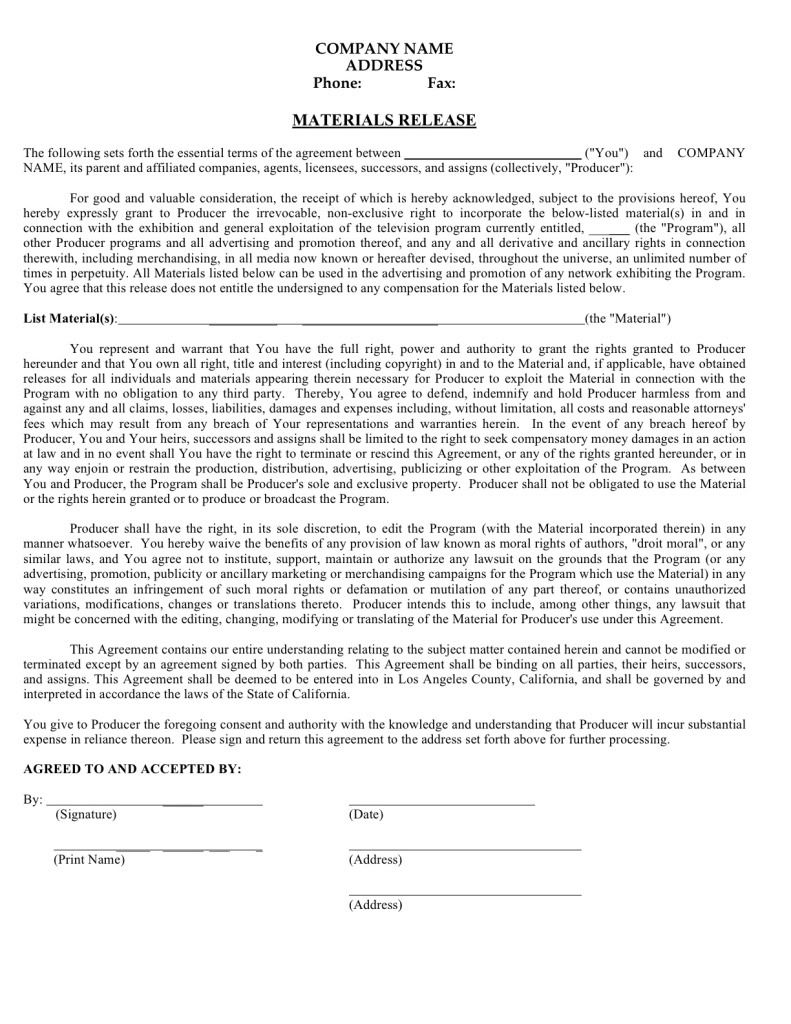
Standard Materials Release

Much like locations, photos and visual elements you wish to use in your show must be released before airing.  This would include artwork in the background, maps, archival photos, album and magazine covers, etc.  And it especially goes for any photos you want to use full frame or things like Billboard music charts that you often see on shows.

If you don't have permission to use these images and you can't cut around them, you will have to blur them in post.  This can be a nightmare if, say, your characters are having an important conversation while standing in front of a decorative poster.  A good field producer will remove any troublesome decorations from a location before shooting there, and a great producer will even clear images through Getty or another image library and decorate locations with already cleared images.

In the case of any artwork, this must be signed by the creator or rights holder, regardless of who currently owns the physical piece.

Here is a standard materials release:
Click here to download Materials Release as a word doc